Urban Hoof

By Lorenzo Gonzalez
Dec 25, 2025
Ryder
On August 10, 2022, a carriage horse named Ryder had just finished a 7.5-hour shift when, on his way back to his stable, he collapsed on the corner of 50th Street and 9th Avenue. It was a hot summer August day when Ryder fell to his knees as his driver, Ian McKeever, would continuously strike Ryder with the reigns ordering, “Get up!”- which led to Ryder kneeling over on his side, and eventually collapsing.
Ryder was doused with cold water for approximately 45 minutes while bystanders witnessed the unfortunate incident. Ryder was eventually mounted in an NYPD truck and driven away. Unfortunately, this is not the first or last incident regarding the horse and carriage industry.
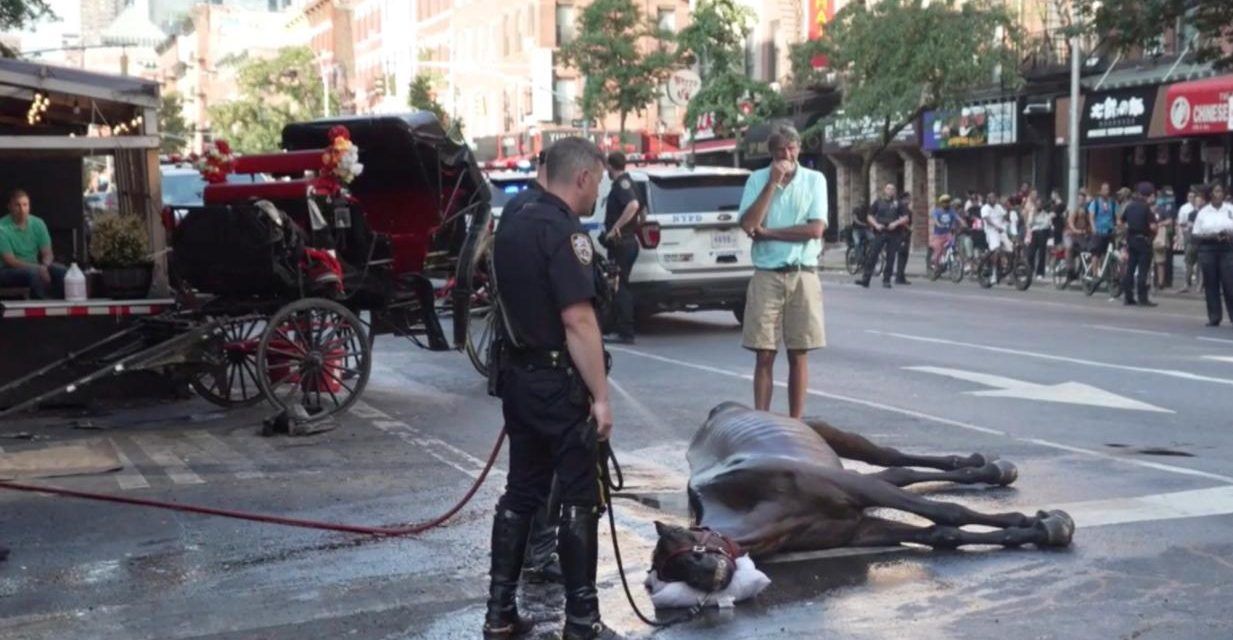
Ryder being doused with water. Photo via New York Post.
Historical Context
With the arrival of European colonizers, horses were one of the many things that were brought over to the United States. For the next 3 centuries, they helped power the city’s construction, law enforcement, ambulances, street cleaning, delivery services, and, yes, of course, transportation. The city was full of horses, with estimates at one point being up to 200,000 horses across the city at its peak.
The Dutch would bring horses to New Amsterdam to carry big loads and operate certain mills, and the English would eventually import horses for racing. Horses were essential to the city and would even appear in official records for taxation and regulation purposes. The records would also document regulations about where and how horses could be bought, sold, water and fed.
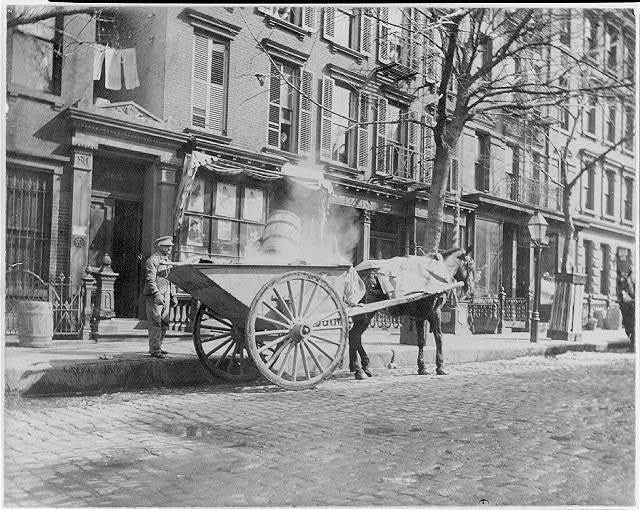
Horse-drawn ash cart in New York City (c. 1896). Photo by Elizabeth Alice Austen, via Library of Congress Prints and Photographs Division.
The first ever horse-drawn in the United States was actually in New York City, and operated along Broadway in Manhattan from Prince to 14th Street beginning in 1832.
The dependency on horses in the city was very evident; other records revealed disturbing details. There was a large number of arraignments in the Police and Magistrate’s Court docket books for offenses related to animal abuse. Because of these offenses, eventually the American Society for the Prevention of Cruelty to Animals (ASPCA) was founded. The first branch was founded in 1866.
Following the turn of the century, the number of horses in the city began to dramatically decrease. The reliance on horsepower was gradually reducing, and between 1910 and 1920, the number of horses decreased from 120,000 to 55,000. With the rise of electric trolleys and eventually the creation of automobiles, horses began to phase out as the primary form of transportation. Despite new technology, the one factor that remained was the romantic allure the horse-drawn carriages managed to endure.
Before the decreasing dependency, horses had a major effect on the enjoyment of Central Park for New Yorkers. A horse-drawn carriage was seen as a symbol of prestige, and as carriages became more accessible to the public, they transformed it into a symbol of leisure and elegance.
Locals and tourists were able to enjoy the serene environment of Central Park while feeling a sense of elegance because of these horse-drawn carriages. The horses have a strong connection with the history of Central Park, and many could argue that theirs major impact helped make what the park is today.
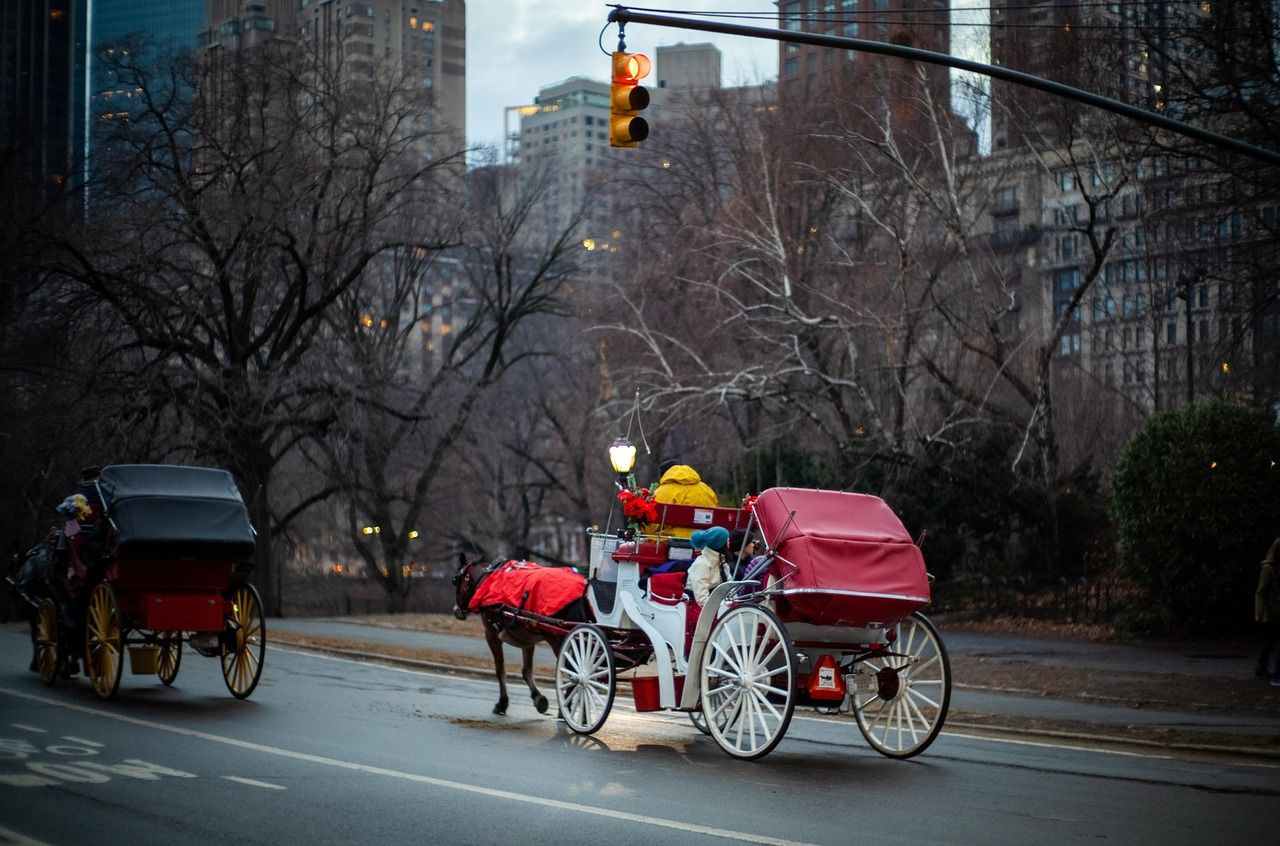
Horse and carriage. Photo by Igor Wang, via Pixabay.
Modern Day
Ryder’s collapse in August 2022 was not the first, nor the last, troubling incident in New York City’s carriage horse industry. Weeks after driver Ian McKeever was acquitted of animal cruelty charges, another horse, Lady, collapsed and died just a few blocks from her Hell’s Kitchen stable in August 2025, reigniting public debate over the welfare of carriage horses. In November 2023, a horse named Gunner broke free from his driver on the West Side Highway, colliding with a vehicle before being safely contained. These events, along with historical accidents documented by the Coalition to Ban Horse-Drawn Carriages, underscore the risks horses face navigating busy city streets.
While the city enforces regulations, including inspections of stables and requirements for stall size, bedding, and veterinary care, critics argue that accidents and health emergencies reveal systemic vulnerabilities. Supporters of carriage drivers emphasize the bond they share with their horses and the traditions of the industry, pointing to careful care routines and adherence to city rules. Yet, the recurring incidents demonstrate the unpredictable nature of horses in urban traffic and fuel calls for change.
The Aftermath
These events have strengthened support for Ryder’s Law, a proposed legislation aiming to phase out horse-drawn carriages by June 2026 in favor of electric alternatives, while providing career transition support for drivers. The debate remains deeply polarized, balancing the cultural and historical significance of carriages with growing concerns for animal welfare and public safety in New York City.
Ryder’s collapse in August 2022 was not an isolated event but a continuing series of incidents that have been occurring for decades. Ryder collapsed after completing a 7.5-hour workday on a hot summer day when he dropped to his knees and collapsed at the intersection of 50th Street and 9th Avenue. His owner and driver, Ian McKeever, pushed him to continue, slapping him with his reins, until a group of bystanders came and poured water on the exhausted horse. Ryder was taken away in an NYPD truck, but the incident brought about concerns for the horse and carriage industry again. Later in the year, Lady, a horse in Hell’s Kitchen, collapsed and died. Later in November 2023, a horse named Gunner got loose on the West Side Highway and crashed into a car before being rounded up. As evidenced throughout history and supported by data collected by the Coalition to Ban Horse-Drawn Carriages, such incidents are common.
Horse-drawn carriages are inextricably linked to the image of New York City, especially Central Park, where, for more than a hundred years, they have represented a synonym for leisure, elegance, and nostalgia. But beneath the romantic veneer of the industry lies the constant tug of war between tradition and modern concerns for animal welfare and public safety. Ryder, Lady, and Gunner are three stark reminders of how a system beneath historic charm and iconic photo ops is vulnerable to accidents, illness, and even death. Those who defend carriage drivers speak of the bond with horses, careful care routines, and putting regulations into practice. But according to critics, no amount of oversight will ever fully protect horses from the dangers of the city.
The debate has only gotten louder these last few years, in part because of Ryder's Law, proposed legislation aiming to phase out horse-drawn carriages by June 2026, replacing them with electric alternatives while offering career support for drivers. Supporters claimed it was a necessary step to prevent further tragedies, while opponents were quick to frame it as erasing a part of the city's heritage and tradition. The horses are no longer the only topic of the conversation: now, it's about urban ethics, the preservation of history, and the responsibility of New Yorkers balancing an act between nostalgia and humane treatment.
At the time of writing this article, Ryder’s Law, the City Council bill intended to phase out New York City’s horse‑drawn carriage industry, failed to advance out of the Health Committee in November 2025, meaning it will not move forward in the current legislative session. Animal rights advocates have expressed disappointment and hope it will be reintroduced with the next Council, but for now, horse‑drawn carriages continue to operate in the city.
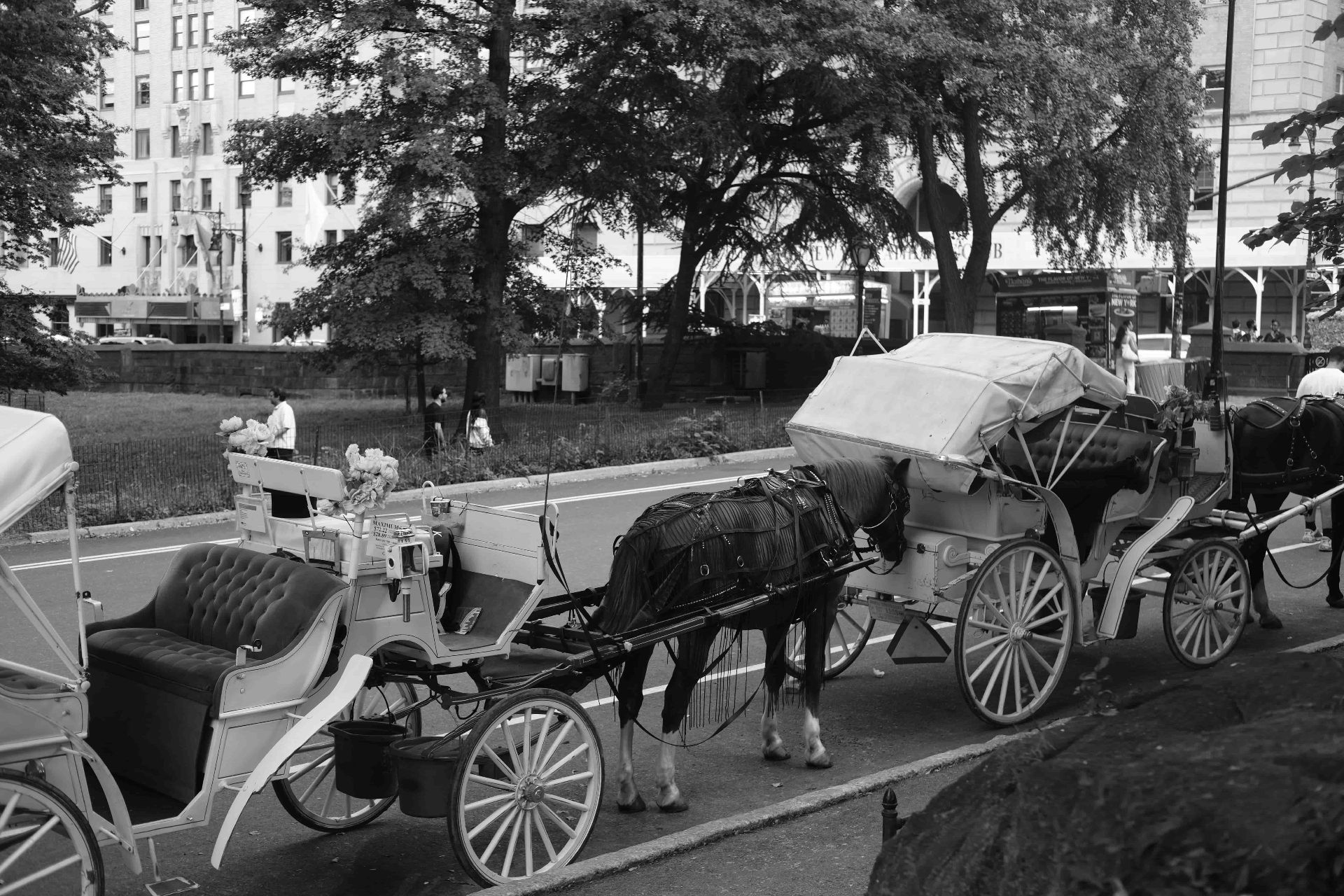
Photo By Lorenzo Gonzalez
The Not Project Take
Regarding The Not Project, the question that emerges from this story is about the sorts of traditions on which the modern city should insist, and whether, in order to protect an iconic image, it's worth risking the lives of living things. It is not merely a question for Manhattan's sidewalks but speaks to the sorts of traditions on which cities choose to insist concerning safety, welfare, and culture on the one hand and livelihood on the other. Clearly, also, any decision will involve consideration for the livelihood of the drivers whose lives they've committed to this work.
In the end, the carriage horse controversy is only a reflection of the city itself: a multifaceted and intricate environment of history, economy, tourism, and morality. Ryder, Lady, and Gunner are more than just a series of headlines in a media cycle, they represent something of what New York citizens are being asked to consider as they consider tradition versus mercy and entertainment versus public safety in a daily struggle to define what they value and what they are willing to do to protect it in both its past and its living form.