New York's Tiniest Island
By Lorenzo Gonzalez
Aug 9, 2025
A Tiny Island?
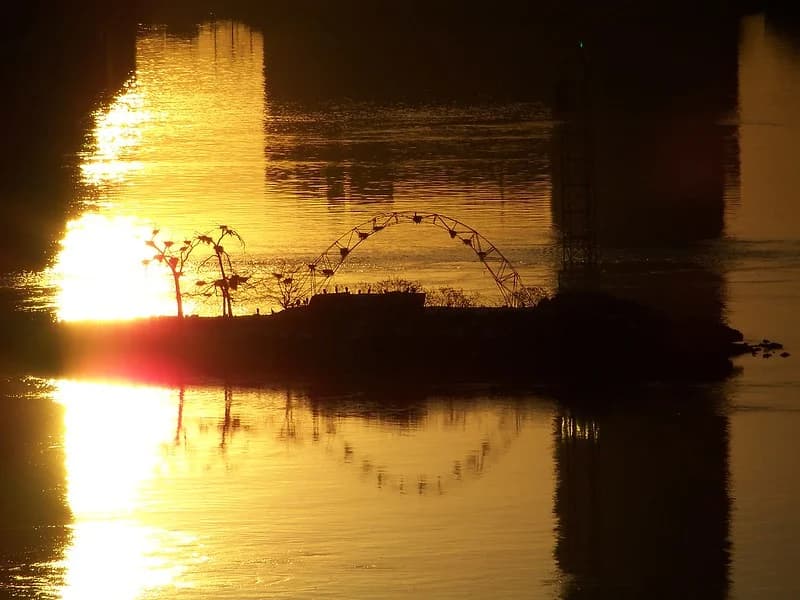
Between Manhattan and Queens on the East River lies a tiny, uninhabited island with a history far larger than itself. Officially known as Belmont Island, though most know it simply as U Thant Island, it remains one of New York’s most forgotten pieces of land. The city is made up of famous islands that carry deep history and recognition, yet few ever mention the others scattered throughout its waterways. This one, oddly enough, is tied to a man who never even stepped foot in New York City.
Origins
The island was created from materials that were excavated by a project funded by William Steinway, a piano manufacturer. The project was an underwater trolley tunnel in the East River to connect Queens and Manhattan. Constructing this tunnel was no easy feat, as it took nearly two decades to complete. Work was initially halted as a dynamite blast in 1892 killed five workers in Long Island City. In 1906, four more workers were killed during an accident that occurred under the island. Excavation continued shortly after. Workers dug out as shaft into the rock outcrop known as Man-o’-War Reef during the construction, and in turn the excavated rubble formed the man-made island, Belmont Island.
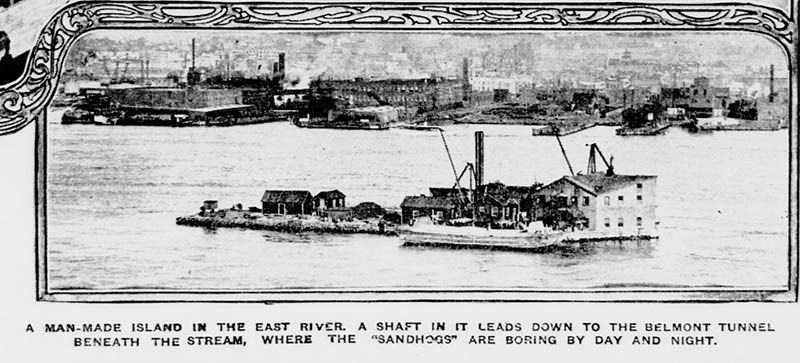
Belmont Island. October 14, 1906 New York-Tribune. Image from Library of Congress, Serial and Government Publications Division.
William Steinway passed away before the completion of the tunnel, but after August Belmont Jr, an American financier, took over the project and funding. The island was named after him shortly after. His importance was evident as he even had his own subway car that still exists. Today the tunnels are still used by the 7 train. Steinway’s foresight had ultimately paid off and so did the sacrifices of the men who built the tunnels.
Events
On August 25, 1972, the island was occupied for 2.5 hours by six activists led by Manhattan and Bronx Borough Presidents Percy Sutton and Robert Adbrams to protest a United Nations speech by Leonid Brezhnev. The island was declared “Soviet Jewry Freedom Island”, a response to the imposition of the diploma tax, a one time payment imposed in the Soviet Union on would-be emigrants who received higher education there. Other notable members of the group that landed on the island include Rabbi Gilbert Klaperman, chairman of the Greater New York Conference on Soviet Jewry, and Sister Rose Thering of Seton Hall University. The group carried a 20x6 foot banner displaying the new name of the island to make known their act of protest. NYPD was dispatched, but later returned as the group had obtained a temporary deed to the island. This act of protest infuriated the Soviet delegation and complained to Secretary General Kurt Waldheim.
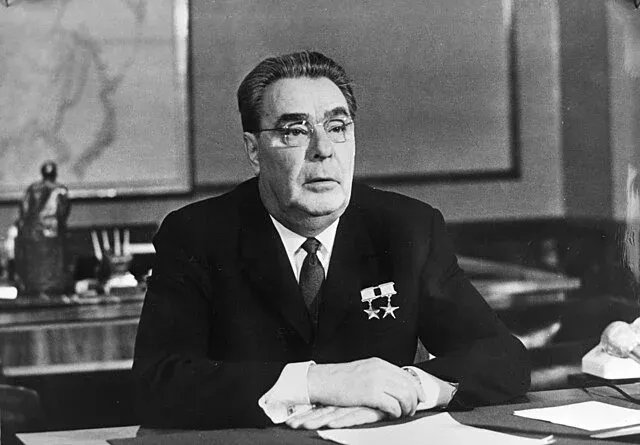
Leonid Brezhnev. Photo by Rob C. Croes / Anefo, via Wikimedia Commons, licensed under CC BY-SA 3.0 NL.
On November 25, 1974, U Thant, the former Secretary-General of the United Nations, had passed away. After his death the island was adopted by a group called the Peace Meditation at the United Nations, a group made up of employees who worked at the United Nations headquarters and followers of the guru Sri Chinmoy. After renovating and greening the surface, on September 16, 1977 the island was dedicated to the memory of U Thant. On October 7, 1982, Belmont Island was formally named U Thant Island and a 30 foot high “oneness arch” was erected in his honor.
In 2004, Belmont Island would have one final takeover, as local artist Duke Riley sailed to the tiny island and proclaimed it as a sovereign nation. This act of protest was in response to the increased security happening across the city for the Republican National Convention. He was later apprehended, but not arrested. The entire incident was filmed for an art piece Riley titled Belmont Island.
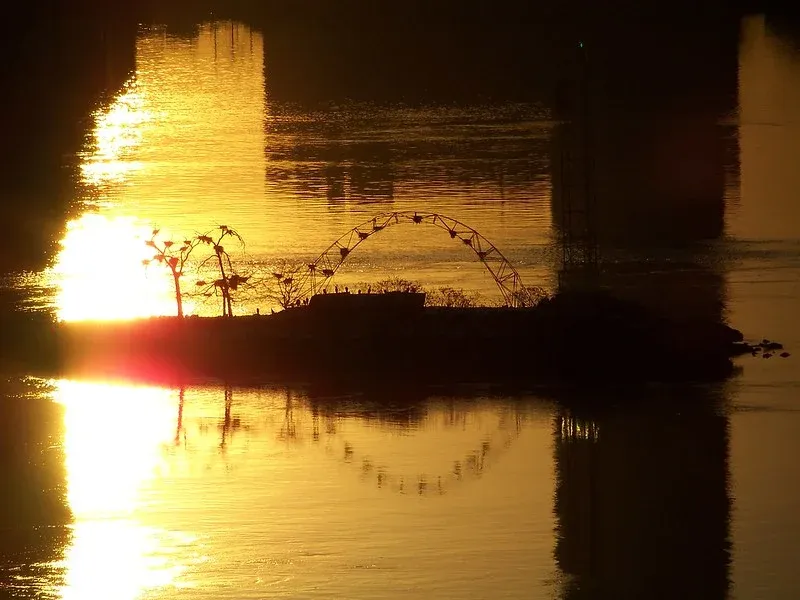
Oneness Arch. Photo by Mark Nazimova, via Flickr, licensed under CC BY-NC-ND 2.0.
Today
Belmont Island is undeniable evidence that New York City is full of history no matter where you go or what you look at. It is said to be the smallest island in the city, yet still serves a purpose. Its everlasting presence is a testimony to the teachings of Chinmoy and U Thant. Today what remains is a rocky and desolate island forgotten and unknown. It was designated an Recognized Ecological Complex, a site for migrating birds. The island is home to a small colony of Double-Crested Cormorants. This protected site assisted in doubling the population of these birds in over a decade.
What We Believe
We believe New York City should always preserve its history, the same way we try to preserve our city in its current state. If it was not for the deep history this city holds, it would not be a great city, and we should recognize and be grateful for how far we have come and everything that got us here. Belmont Island, or unofficially U Thant Island, can still have a purpose in this city, with respect to our avian friends. What is that purpose? That story has yet to be written — and maybe that’s the point. In a city obsessed with what’s next, forgotten places like this remind us that there is still space to dream about what could be.
This article is dedicated to the 10 men who lost their lives building the tunnel.